Social media has become a central part of modern life, shaping how people communicate, think, and behave. Today, individuals check their phones within minutes of waking up, and throughout the day, they rely on platforms for news, entertainment, and connection. As a result, social media strongly influences daily lifestyle habits, both positively and negatively. Therefore, understanding these effects can help people make more mindful choices and maintain a balanced routine.
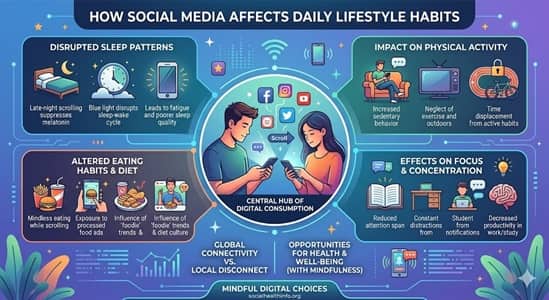
Impact on Morning and Night Routines
Social media significantly shapes how people start and end their day. Instead of focusing on productive habits, many users turn to their screens first thing in the morning. Consequently, this behavior can delay important tasks and reduce early-day efficiency.
- Many people scroll through feeds immediately after waking up
- Morning productivity often decreases due to digital distractions
- Late-night usage disrupts sleep schedules
- Blue light exposure reduces sleep quality and duration
As a result, inconsistent sleep patterns and fatigue become common issues. Therefore, reducing screen time before bed can improve overall well-being.
Effects on Eating Habits and Physical Activity
Social media also influences how people eat and stay active. While some content promotes healthy living, other content encourages poor habits. Consequently, users often adopt behaviors based on what they consume online.
- Distracted eating increases when users scroll during meals
- Food-related content triggers cravings and overeating
- Fitness influencers encourage exercise and healthy routines
- Unrealistic body standards may cause pressure or dissatisfaction
On the one hand, social media can motivate healthier choices. On the other hand, it can create unrealistic expectations. Therefore, users should focus on balanced and realistic goals.
Influence on Mental Health and Emotional Well-being
Mental health experiences strong effects from social media usage. Although it helps people stay connected, it also introduces emotional challenges. As a result, users may experience both positive and negative outcomes.
- Social platforms strengthen communication with friends and family
- Constant comparison leads to self-doubt and dissatisfaction
- Exposure to idealized lifestyles increases anxiety
- Frequent notifications create stress and mental fatigue
Consequently, emotional balance becomes harder to maintain. However, limiting usage and curating content can support better mental health.
Impact on Productivity and Time Management
Social media plays a major role in how people manage their time. Because platforms are designed to capture attention, users often lose track of time. As a result, productivity decreases in daily tasks.
- Endless scrolling leads to time wastage
- Short-form videos increase distraction levels
- Procrastination becomes more frequent
- Educational content can support learning and skill development
However, when used wisely, social media can enhance productivity. Therefore, setting boundaries and using time-tracking tools can improve efficiency.
Changes in Social Behavior and Communication
Social media has transformed communication styles and social interactions. While digital communication offers convenience, it may reduce face-to-face engagement over time.
- People prefer texting over direct conversations
- Emotional expression becomes limited in online interactions
- Global connectivity improves communication across distances
- Interpersonal skills may weaken due to reduced in-person contact
Nevertheless, social media allows people to stay connected regardless of location. Therefore, balancing online and offline communication remains essential.
Influence on Consumer Behavior and Lifestyle Choices
Social media strongly shapes purchasing decisions and lifestyle trends. Influencers and advertisements introduce new habits that users often follow without careful evaluation.
- Influencer marketing drives product popularity
- Trends influence fashion, diet, and daily routines
- Impulsive buying increases due to constant exposure
- Users adopt habits based on viral content
As a result, spending patterns and lifestyle choices change rapidly. Therefore, critical thinking becomes important before following trends.
Effects on Attention Span and Cognitive Habits
Frequent social media usage affects how people focus and process information. Because users constantly switch between content, their attention span decreases over time.
- Multitasking reduces deep focus ability
- Constant notifications interrupt concentration
- Quick content consumption shortens attention span
- Digital discipline can improve cognitive performance
However, users can improve focus by managing screen time effectively. For instance, turning off notifications and scheduling breaks can help restore concentration.
Conclusion
Social media plays a powerful role in shaping daily lifestyle habits. While it offers connection, information, and inspiration, it also introduces challenges related to sleep, mental health, productivity, and behavior. Therefore, individuals must use social media consciously and set boundaries to maintain a healthy balance. By doing so, they can enjoy its benefits without compromising their well-being.
FAQs
Q1. How does social media affect sleep habits?
Social media disrupts sleep because users often stay online late at night. Additionally, screen exposure reduces melatonin levels, which makes falling asleep harder.
Q2. Can social media improve lifestyle habits?
Yes, social media can encourage positive habits. For example, fitness content, educational posts, and motivational communities can inspire healthier routines.
Q3. Why does social media reduce productivity?
Social media reduces productivity because it distracts users with continuous notifications and engaging content. As a result, people spend more time scrolling instead of completing tasks.
Q4. Does social media impact mental health?
Yes, social media affects mental health both positively and negatively. While it helps people stay connected, it can also cause comparison, stress, and anxiety.
Q5. How can someone use social media responsibly?
People can use social media responsibly by setting time limits, avoiding excessive scrolling, and focusing on meaningful content that adds value to their lives.